
'What gives hope is that Modi's own leadership is vitally linked to his capacity to deliver on the economic front. Indeed, if he succeeds, India's foreign policies will have changed beyond recognition,' feels Ambassador M K Bhadrakumar.

Transcript of the Ganesh Natarajan chat on rediff on Friday.
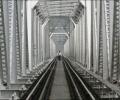
India has planned 14 strategic railway lines in areas bordering China, Pakistan and Nepal, but most of these projects are stuck for want of funds. Anusha Soni reports

After weighing all the costs and benefits, the next administration is likely to reduce and restructure assistance to Pakistan but not to end it altogether, says Daniel S Markey.

As an entrepreneur, one has to evaluate and learn from each customer and continually improve.

'If not, we can become frighteningly chaotic, more chaotic than what we are today.' 'In today's environment in the country, we still have a window of opportunity.'

When Prime Minister Modi observes the first anniversary of his government at Nagla Chandrabhan, Deendayal Upadhyaya's birthplace in Mathura, on Monday, he shall be essentially reiterating his commitment to achieving the ideal of Upadhyaya's 'Dharma Rajya', a State free of inequality and of division, says Dr Anirban Ganguly.

President Pranab Mukherjee on Monday addressed the first joint sitting of Parliament as mandatorily required under the Constitution after the general elections. The address is the political, economic and foreign policy road map of the Narendra Modi government and covers virtually all crucial areas.

Muzzling NGOs is unbecoming of a democracy. Self-confident democracies encourage, indeed applaud, the involvement of citizens' associations, including NGOs, in social and political decision-making and development planning. Instead, our paranoid government bullies and terrorises them, says Praful Bidwai.

Two years into power, there is very little to show for the Modi government by way of 'achievements' on the foreign policy front, and his China, Pakistan policies are gasping for breath, says Ambassador M K Bhadrakumar.
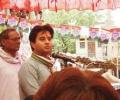
Despite the strong anti-incumbency sentiment against the Shivraj Singh Chouhan government, the Congress neither had the strategy nor an organisation to cash in, says N D Sharma

We're behaving like frogs in warm water. We swim around untroubled, cooled by our faith in Indian liberal democracy. We are blind to the bubbles popping around us, the bubbles warning of fundamental changes, says Mihir S Sharma.

Amit Shah is the man of the moment. The architect of the BJP's stunning transformation in the Hindi heartland during the Lok Sabha elections is all set to emerge as the CEO of Modi's political dreams and the Rashtriya Swayamsevak Sangh's cultural passion, says Sheela Bhatt.

When Italy's cash-strapped soccer clubs meet on Monday to prepare for a new deal on broadcast rights, their deliberations will be coloured by the unhappy knowledge that Italian football is in a dismal state and viewers are switching off.

Boosted by handsome royalty from oil facilities at Barmer, the Rajasthan government has spent nearly Rs 30,000 crore on various social welfare schemes in the last four-and-a-half years. Chief Minister Ashok Gehlot tells Business Standard's Mayank Mishra that the state's better performance on various socio-economic indices is a result of that. The excerpts:

'You want a steady, confident, self-assured and highly skilful hand at the till. 'It is a pity that the BJP has decided to deprive itself of such a hand at this politically sensitive time.' 'It is like sacking your surgeon in the middle of your brain surgery,' says S Muralidharan.

This is the first time the fight is between mother and son. Both sides don't look in the mood to relent: Advisors and spin doctors have been hired, lawyers have been consulted.

On Thursday, November 6, the Washington Post newspaper reported that controversial American diplomat, Ambassador Robin Raphel, had her office and home searched by the FBI. This most unusual development likely raised much cheer at India's ministry of external affairs, in whose flesh Raphel had been a thorn through much of her tenure in the first Bill Clinton administration in the early and mid-1990s by her anti-India and pro-Pakistan stand. Seventeen years ago, as she was about to step down as Assistant Secretary of State for South Asian Affairs, Raphel granted an exclusive interview to Aziz Haniffa and India Abroad, the leading Indian-American weekly newspaper, which is now owned by Rediff.com The July 1997 interview, which provoked a raging controversy in both capitals, Washington, DC and New Delhi, is reproduced here...

'Human rights violations are there in rural areas and in cities. In rural areas it is crude and in the open. In urban areas it is well hidden.' 'Awareness has grown several fold. India has 160 national and state human rights institutions. No other country in the world has this.' 'Unfortunately the right to association, right to assembly, freedom of expression, right to protest and discuss are all being curtailed systematically one by one.'
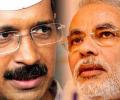
'The AAP is likely to take root in some metropolises -- although it won't be easy to replicate the small-scale Delhi model with equal intensity or cadre-strength in a large state,' says Praful Bidwai.

'Narendra Modi has had very good luck. Firstly, the fall of oil prices. You don't get that very often in your life and you certainly don't get that often when you are in government.' 'Secondly, the fantasy of Indian reforms has led to very strong capital inflows to have made his job much, much easier.' 'You ride the winds in times of fortune and he hasn't done that. At least, not yet.' 'Those winds of fortune which are blowing your way can certainly turn around easily. There are quite a few headwinds coming up. He may well, history will show, have missed the opportunities that existed.'

More than a year after he was nominated by President Barack Obama, the US Senate, defying the powerful pro-gun lobby National Rifle Association, voted to confirm Dr Vivek Hellegere Murthy as the first Indian American US Surgeon General and the youngest ever at age 37, in a cliff-hanger of a 51-43 vote.
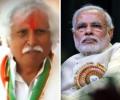
Narendra Modi's mother washed utensils to make a living. Madhusudan Mistry's grandmother, who brought him up, was a vegetable vendor. Mistry's trajectory from poverty to membership of the all powerful Congress Working Committee is moving. the man who has Rahul Gandhi's ear and is all set to take on Narendra Modi in Vadodara, speaks to Rediff.com's Sheela Bhatt in a fascinating interview.

It is easy to foretell that negotiating a comprehensive and final agreement on the Iran nuclear issue is by no means an easy task. It involves hard negotiations, but the hardest step has been taken, says Ambassador M K Bhadrakumar, who was among the first group of foreigners to visit the the top-secret Arak plant hidden behind barren mountains south of Tehran.
